A robot cell should be built twice, the first time on screen. Simulation is not just an animation. It is a tool for validating an automation investment before a single bolt is tightened.
Automation is widely discussed, and robotics is often associated with promises of efficiency, flexibility and competitiveness. But when the discussion turns practical, the same question always comes up: How do we know this will work in our environment?
That is a fair question. And it is exactly what simulation is designed to answer.
In this blog, we look at three different scenarios where simulation fundamentally changes the direction of an automation project. Although the starting points vary, they share one common factor. Decisions should not be based on assumptions. In robot cell design, they are expensive.
Robot Cell Design Starts with a Feasibility Study
In many industrial companies, the situation is familiar. The board or corporate management assigns the task of exploring automation opportunities. The requirement is clear, but where do you start? There are dozens of suppliers, each promising something different, and missteps cost both money and credibility.
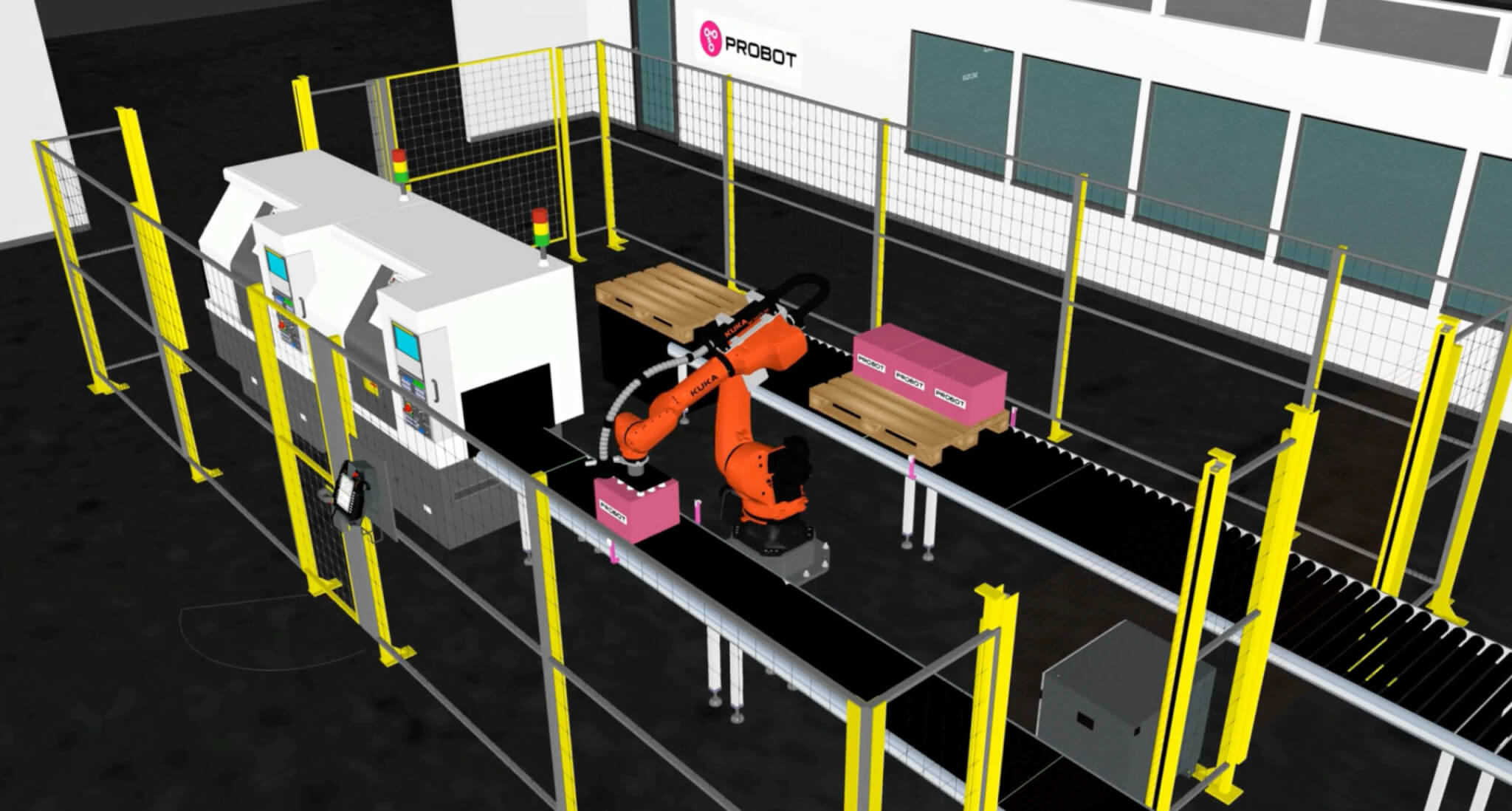
In this situation, simulation adds clarity. It provides a measurable foundation for robot cell design and concept development. Instead of presenting a hundred-page report or slides full of features, you can demonstrate what the solution would actually look like in your production environment, with accurate dimensions, real products and real-world constraints.
Simulation quickly reveals whether the concept works. Can the robot reach the target? Does the cell fit within the available floor space? Are additional sensors or conveyors required? What is the realistic cycle time?
When everyone shares the same digital view of the future solution, the conversation becomes far more concrete. Instead of debating assumptions, you are evaluating a shared model.
– In simulation, we do not just analyze individual components, we analyze the entire production system. We see how different stages interact and where real performance is created. That is how we ensure the solution works in practice before implementation, summarizes our simulation specialist and project coordinator Juha Polvela.
In practice, this means that simulation defines the entire structure of the cell: the placement of equipment and conveyors, the required sensors and, for example, the positioning of RFID readers. RFID identification enables automatic product recognition directly from the pallet, which is essential for applications such as traceability and quality control. At the same time, the infeed and outfeed of products or pallets can be tested, as well as the most efficient pallet pattern.
We have also implemented a robot cell for handling RFID tags. You can explore this RFID robot cell project in our reference cases.
When the Robot Cell Investment Is About to Be Approved
The second scenario is an investment that has been under consideration for a long time and finally receives the green light. The budget is approved and expectations are high.
This is precisely where many projects go wrong. Under pressure to deliver results quickly, the temptation to jump straight into implementation is strong. But every untested assumption is a risk. That risk typically materializes on the shop floor. Fixing problems at that stage is significantly more expensive.
At this phase, robot cell simulation acts as a decision validation tool. It verifies that the robot can reliably reach all required positions. Different robot models can be compared. Grippers can be tested. You can evaluate how small process changes affect the overall outcome. Layout alternatives can be explored without dismantling and rebuilding physical equipment.
– Simulation also allows us to optimize energy consumption. Conveyor distances and robot motion paths directly impact total load, and these parameters can be fine-tuned before implementation, Juha points out.
“Simulation also makes it possible to optimize energy consumption before implementation.”
Juha
A well-executed simulation also models control logic.
– By defining signal flows between components, such as sensors and the robot, in advance, we avoid many commissioning surprises, Juha explains.
The accuracy of a simulation always depends on the input data. With proper 3D models and precise process data, the result is a millimeter-accurate analysis with reliable cycle time calculations.
– I always start a simulation project with the same question: what problem are we actually solving? Once that is clear, simulation becomes a powerful way to turn ideas into functional solutions, Juha says.
When a Previous Robot Cell Implementation Failed
The third scenario is perhaps the most challenging. The company has already attempted automation, and the experience was disappointing. Maybe the supplier overpromised, the delivery did not match the agreement, or the project ran over schedule and budget.
Trust is low and the threshold for launching a new initiative is high. Simulation does not erase past experiences, but it changes the starting point. When a project begins with simulation, everyone can see in advance what is being built. There are no surprises or conflicting interpretations of what was agreed upon. The customer and project team review the same digital model and discuss the same reality.
That matters.
When previous setbacks have left their mark, transparency is a prerequisite for rebuilding trust. Simulation provides exactly that. A shared, visual representation of the future solution that can be evaluated, challenged and refined before commitment.
Simulation shifts risks away from production and into a phase where they can still be controlled.
In the virtual world, mistakes are inexpensive.
On the production floor, they are not.
Whether the case involves an initial feasibility study, a major investment or a renewed attempt after disappointment, the value of simulation remains the same. Risks are identified while they are still manageable.
At Probot, robot cell design always starts with simulation. Not because it is an impressive tool, but because it is the smart way to proceed.
Frequently Asked Questions About Robot Cell Design and Simulation
Is robot cell simulation necessary even for a small investment?
The need depends on process complexity and risk level. The more variables involved, such as layout constraints, multiple products or variable infeed, the greater the value simulation provides.
How accurate is a robot cell simulation?
Accuracy depends on the input data. With correct 3D models and reliable process data, cycle time calculations and reach analyses are highly accurate.
Can robot cell capacity be estimated without simulation?
Capacity can be estimated, but without simulation it cannot be validated. Simulation exposes bottlenecks before they appear in production.
Is a digital twin the same as a robot cell simulation?
Simulation can be part of a digital twin. In robot cell design, simulation focuses specifically on functionality, capacity and collision detection.
Before moving forward with a robot cell investment decision, the solution should be seen in action. Get in touch to discuss your robot cell design and evaluate what type of simulation would bring the most value.
Probot Oy – Specialist in Robotics.